Stay Cool 6–10 PM Without a High Electricity Bill (2026)

To stay cool from 6 PM to 10 PM without a high electricity bill, cool your home before 6 PM, then let it “coast” through peak hours with the AC at 26–27°C and a ceiling fan running. Keep heavy appliances off until after 10 PM. Many power companies charge two to three times more per unit during evening peak hours, so this one habit cuts the most expensive part of your bill.
In this article
- Why Does Electricity Cost More from 6 PM to 10 PM?
- What Are the Peak Hours Where You Live?
- Your Home Is a Thermal Battery
- The 3-Step Evening Cooling Plan
- How Much Can a Fan and 26°C Really Save?
- A Real-World Example With Numbers
- Natural Cooling Tricks That Cost Nothing
- Which Appliances Should Wait Until After 10 PM?
- How to Check If You Pay Peak Rates
- When You Should Not Cut the AC
- Frequently Asked Questions
- Start Your Peak-Hour Plan Tonight
Learning how to stay cool from 6 PM to 10 PM is one of the smartest money moves a household can make in 2026. These four evening hours are when families come home, cook dinner, switch on the TV and turn the AC to its coldest setting, all at the same time. Power grids feel the strain, and many utilities pass that cost on through higher peak-hour rates.
The good news? You don’t have to sweat through the evening to save money. You only need to change when your AC works hard, not whether you stay comfortable. This guide shows you exactly how, with clear numbers, a simple daily plan and a few cooling tricks most people have never tried.
Why Does Electricity Cost More from 6 PM to 10 PM?
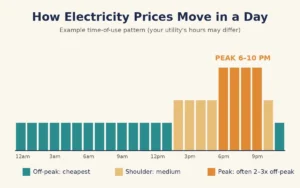
Electricity is not always priced the same. Under a time-of-use (TOU) plan, the price of one unit (1 kWh) changes depending on the hour of the day:
- Peak hours: the busiest period, usually in the evening. Prices are highest.
- Off-peak hours: late night, early morning and often midday. Prices are lowest.
- Shoulder hours: the in-between period, with medium prices on some plans.
According to EnergySage, peak hours usually fall in the late afternoon and evening, and peak rates can be two or three times higher than off-peak rates.
Why has the peak moved into the evening?
Here’s a point most cooling guides miss. Rooftop and grid solar panels now produce a lot of power during the day. But as soon as the sun sets, solar output drops to zero, while home demand keeps climbing. Power companies then have to switch on costly backup plants to fill the gap. That’s why the expensive window has shifted toward the early evening in many countries, and why 6 PM to 10 PM is now the hour block to watch.
The AC isn’t the problem. Running it hardest at the most expensive hour is.
What Are the Peak Hours Where You Live?
Peak hours depend on your country, your power company and even the season. Here are a few real examples:
| Region | Typical peak window |
|---|---|
| Many US utilities (e.g., California) | 4 PM – 9 PM |
| Pakistan (NEPRA tariff terms): Mar–May and Sep–Nov | 6 PM – 10 PM |
| Pakistan: Jun–Aug | 7 PM – 11 PM |
| Pakistan: Dec–Feb | 5 PM – 9 PM |
| Karachi (K-Electric): Nov–Mar / Apr–Oct | 6 PM – 10 PM / 6:30 PM – 10:30 PM |
The Pakistan timings come from a NEPRA decision, which notes that higher peak rates apply for 4 hours a day and off-peak rates for the remaining 20 hours. Timings can be revised, so always confirm with your own power company.
💡 Key insight: Peak hours cover only about 4 hours of the day, roughly 17%. Shift your heaviest cooling out of that small window, and the other 20 hours carry your comfort at a lower price.
Your Home Is a Thermal Battery
Think of your home like a phone battery, except it stores “cool” instead of electricity. Walls, floors, furniture and even the air inside can hold coolness for hours.
- Charge it between 3 PM and 6 PM, when power is cheaper.
- Let it slowly drain between 6 PM and 10 PM, with the AC doing only light work.
- Recharge it after 10 PM if needed, at the off-peak rate.
Why do rooms feel hottest after sunset?
Your roof and walls soak up heat all afternoon. After sunset, they slowly release it back into the rooms. This “heat lag” is why many homes feel warmest around 7–9 PM, right in the peak window. Pre-cooling fights this lag before it begins, so your AC doesn’t have to battle it at the highest price.
Charge your home with cool air before 6 PM, and it pays you back all evening.
The 3-Step Evening Cooling Plan
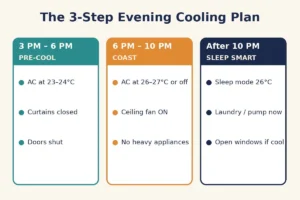
This plan follows advice from official energy agencies. California’s state guidance, shared by the California Department of Food and Agriculture, recommends pre-cooling earlier in the day and keeping the thermostat at 78°F (about 26°C) or higher during peak demand.
Step 1: How do you pre-cool from 3 PM to 6 PM?
- Set the AC to 23–24°C in the room your family uses in the evening.
- Close curtains and blinds on west- and south-facing windows by 2 PM.
- Keep doors to unused rooms shut so cool air stays where you need it.
Step 2: How do you coast from 6 PM to 10 PM?
- Raise the AC to 26–27°C, or switch it off if the room stays comfortable.
- Turn on the ceiling fan at medium speed.
- Use the AC’s “Dry” mode on humid evenings. Removing moisture makes the air feel cooler with less effort.
Step 3: How do you sleep smart after 10 PM?
- Switch to sleep mode at 26°C. It raises the temperature slowly as you sleep.
- Run the washing machine, iron or water pump now.
- If the night air is cooler than indoors, open opposite windows for cross-ventilation.
⚡ Quick win this week: Use your AC remote’s timer tonight. Set it to switch from 24°C to 26°C at 6 PM. It takes two minutes, and you’ll never forget again.
How Much Can a Fan and 26°C Really Save?
Small changes in temperature make a big difference to your AC’s workload.
- Every degree counts: San Patricio Electric Cooperative notes that setting your AC just one degree below 78°F can raise cooling costs by up to 6%.
- Bigger jumps save more: California’s guidance says setting the AC 5°F higher can save up to 20% on cooling costs.
- Fans let you go higher: According to the US Department of Energy, cited by the University of Florida Office of Sustainability, a ceiling fan lets you raise the AC by 2–4°F (about 1–2°C) while still feeling cool.
Does the fan save power on its own?
No, and this is a common mistake. A fan only saves money when you raise the AC temperature at the same time. If you keep the AC at 20°C and add a fan, you’re actually using more power. The fan’s job is to make 26°C feel like 24°C.
What about countries that recommend 24°C?
Some utilities, such as Dubai’s DEWA, have asked residents to set the AC to 24°C in occupied rooms. That’s a good starting point in very hot, humid climates. If 26°C feels too warm, start at 24°C and raise it by one degree every few days until you find your comfort limit.
A Real-World Example With Numbers
Let’s look at one example household with a 1.5-ton inverter AC that runs only in the living room during peak hours, 30 days a month.
| Evening habit (6–10 PM) | Peak units / month | Change |
|---|---|---|
| AC at 20°C, no fan | ~210 | Baseline |
| AC at 26°C | ~150 | About 29% fewer peak units |
| Pre-cool + 26°C + ceiling fan | ~95 | About 55% fewer peak units |
Pre-cooling does add some units in the afternoon, roughly 30 extra off-peak units in this example. But if peak units cost twice as much as off-peak units, moving 115 units out of the peak window still leaves you well ahead.
You’re not using less comfort. You’re buying the same comfort at a cheaper hour.
Does research back this up?
Yes. A UC Berkeley Energy Institute study of homes with smart thermostats found that time-of-use pricing caused large drops in AC use during peak hours, with the biggest savings on the hottest days.
Natural Cooling Tricks That Cost Nothing
These tricks lower the heat your AC must remove in the first place.
Which windows should you cover first?
West-facing windows get the strongest afternoon sun. Cover them first with light-colored, reflective blinds or thick curtains. Dark curtains absorb heat on the window side, so pick light shades facing out.
How can your roof help?
A flat concrete roof can bake all day and radiate heat into top-floor rooms at night. A white reflective roof coating or simple roof shading can make evenings noticeably cooler.
When should you open windows?
Open windows only when the outdoor air is cooler than indoors, usually late at night or early morning. Opening them at 7 PM on a hot day lets warm air rush in and undo your pre-cooling.
What else helps?
- Switch off lights in empty rooms. Old bulbs add heat as well as cost.
- Run the kitchen exhaust fan while cooking, then turn it off.
- Keep electronics like TVs and lamps away from the AC’s sensor, so it doesn’t read the room as hotter than it is.
Which Appliances Should Wait Until After 10 PM?
Many utilities, including those quoted by ABC7 New York, advise shifting laundry and dishwashing to off-peak hours. Here’s a simple sorting list:
| Move to after 10 PM (or before 6 PM) | Fine to use during peak |
|---|---|
| Washing machine and dryer | LED lights |
| Iron | Ceiling and pedestal fans |
| Water pump and electric water heater | Phone and laptop charging |
| Dishwasher and electric oven | Wi-Fi router and TV (in moderation) |
| Electric vehicle or e-bike charging | Microwave for quick reheating |
Cooking on a stove or oven during peak hours also heats the house, which makes the AC work harder. Cook earlier in the afternoon or use a microwave, air fryer or pressure cooker in the evening.
How to Check If You Pay Peak Rates
This is the practical step most people skip. Your savings depend on your meter type.
- Look at your latest bill. If it shows two readings, labeled “peak” and “off-peak,” you’re on a time-of-use plan.
- Check your power company’s website for the exact peak hours in your season.
- Read the meter display. Many smart meters scroll through separate peak and off-peak readings.
- Use your utility’s app, if it has one, to see hour-by-hour usage.
What if I have a single-rate meter?
You’ll still save. Raising the thermostat and using a fan lower your total units, which can keep you out of a costlier usage slab. You’ll also help reduce grid stress and power cuts on hot evenings. To understand the other forces pushing your bill up, read why your electricity bill is rising in 2026.
When You Should Not Cut the AC
Saving money should never put health at risk. Keep the AC running at a comfortable setting during peak hours if:
- An elderly person, a baby or someone with a heart or breathing condition lives with you.
- There’s an official heatwave warning in your area.
- Indoor temperatures climb above about 30°C and you feel dizzy, weak or unusually tired.
In these cases, keep cooling one room well and save elsewhere, such as by delaying laundry and other heavy appliances.
Frequently Asked Questions
Is it cheaper to turn the AC off from 6 PM to 10 PM?
If you pay peak rates, yes. But pre-cooling first and running the AC at 26–27°C with a fan is usually the best balance between comfort and cost.
Does pre-cooling waste electricity?
It uses some extra units in the afternoon, but those units are cheaper. On a time-of-use plan, the savings from avoiding peak rates usually outweigh the extra use.
What is the best AC temperature during peak hours?
Many energy agencies recommend 78°F, which is about 26°C. With a ceiling fan, most people feel comfortable at this setting.
Is an inverter AC better for peak hours?
Yes. An inverter AC slows down instead of switching fully on and off, so it uses less power when holding a steady temperature like 26°C.
Why are peak hours different in summer and winter?
Sunset times and daily routines change with the seasons. As evenings get longer in summer, the peak window often shifts later, for example from 6–10 PM to 7–11 PM in Pakistan.
Start Your Peak-Hour Plan Tonight
You now know how to stay cool from 6 PM to 10 PM without paying peak-hour prices for every degree of comfort. Here’s your quick action list:
- Check your bill to see if you have a peak/off-peak meter and note your local peak hours.
- Close curtains on west-facing windows by 2 PM.
- Pre-cool your main room to 23–24°C between 3 PM and 6 PM.
- At 6 PM, raise the AC to 26–27°C and switch on the ceiling fan.
- Use Dry mode on humid evenings.
- Delay laundry, ironing, the water pump and EV charging until after 10 PM.
- Switch to sleep mode at 26°C at bedtime.
- Compare next month’s peak units with this month’s bill.
Small timing changes, repeated every evening, add up to real savings by the end of the season. Start tonight.

Muhammad Amjad Butt
Founder of HomeKiTips
Muhammad Amjad Butt is the founder of HomeKiTips. He writes practical guides on home repair, maintenance, cleaning and decor. Each guide is built from manufacturer instructions, building standards and current cost data, then turned into clear steps that anyone can follow. For structural work, he always recommends a qualified tradesperson.
You may also like
Best Thermostat Temperature to Save Electricity in Winter & Summer (Plus 7 Hacks)
Set 19–20°C (66–68°F) in winter and 24–26°C (75–78°F) in summer. Learn the best thermostat temperature to save electricity, plus 7…
Best Fridge Temperature to Save Electricity (Plus 7 Easy Hacks)
Find the best fridge temperature to save electricity: 4°C fridge, -18°C freezer. See what dial 1–7 means and try 7…

How to Reduce Moisture in Your Home
Learn how to reduce moisture in your home to stop hidden leaks, cockroaches and dust mites, with safe humidity levels…
Questions and tips from readers (2)