How Long Does a GRP Fibreglass Flat Roof Last? (Year-by-Year)
Quick answer: A well-laid GRP fibreglass flat roof usually lasts 25 to 30 years, and many go past 30 with basic care. Most GRP systems come with a 20 or 25-year materials warranty. A poorly laid one can start leaking in under 10 years. The difference is not the material. It is the deck underneath, the weather on install day, the drainage, and the topcoat.
Who this guide is for: “GRP” is the UK name for this roof, and most details here (18mm OSB3 decks, BS 6229 falls, prices in £) follow UK practice. In the US the same system is usually called a fiberglass flat roof. It is less common there than TPO, EPDM or modified bitumen. US readers will find dollar prices in the cost section below.
Most lifespan articles just give you a number. This one is different. Below is a year-by-year timeline of what actually happens to a GRP roof, from the day it is laid to the day it needs replacing. You will see what to check at each stage, and what quietly shortens its life.

GRP Fibreglass Flat Roof Lifespan at a Glance
| Roof type | Typical lifespan | Common warranty |
|---|---|---|
| GRP fibreglass | 25 to 30+ years | 20 or 25 years (materials) |
| EPDM rubber | 30 to 50 years | 20 to 25 years |
| Torch-on felt | 10 to 20 years | 10 to 15 years |
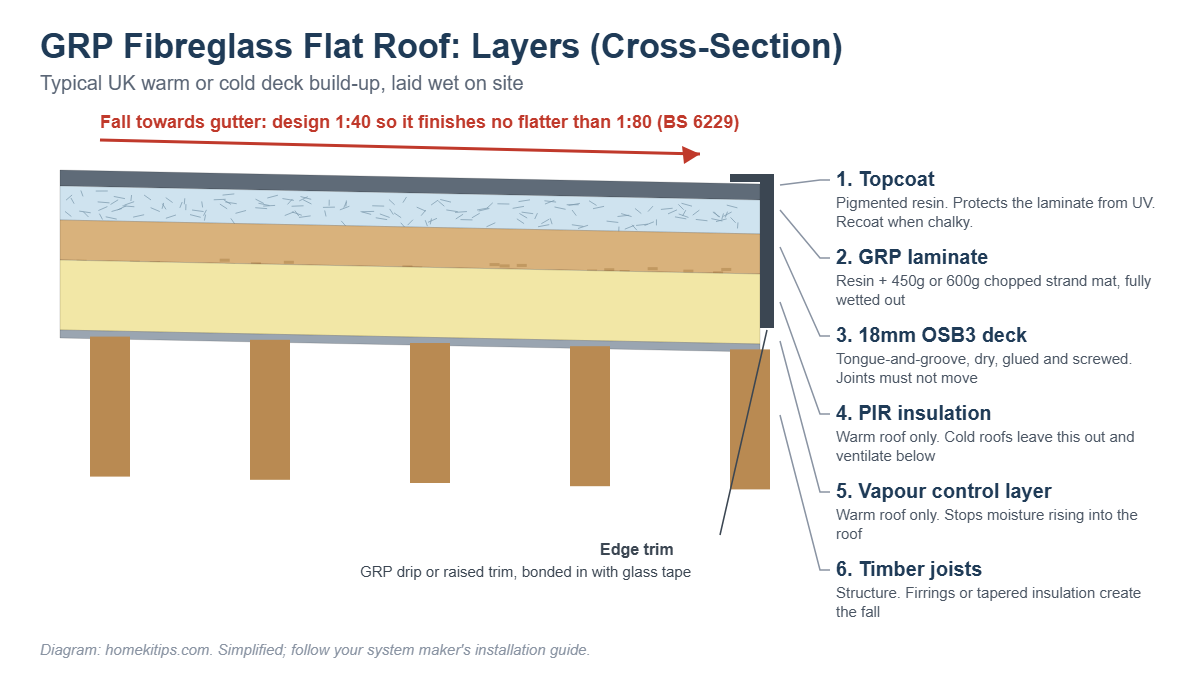
GRP stands for Glass Reinforced Plastic (or Polyester). It is made by laying a chopped strand glass mat onto a timber deck, soaking it in resin, and finishing it with a coloured topcoat. Once it cures, it becomes one solid, seamless shell. Cured fibreglass is inert, so it does not rot or rust. That is the main reason it lasts so long.
The GRP Roof Life Timeline: Year 0 to Year 30+
Year 0: Install Day Decides Almost Everything
The first day matters more than the next 25 years. A GRP roof is built wet, on site. So the weather and the installer’s skill go straight into the final roof.
- Dry, mild weather is a must. Suppliers like SIG Roofing say GRP should go on a new, dry deck at no less than 7.5°C. Damp or cold conditions leave soft, tacky patches that fail early.
- Not too hot either. Topcoat should not go onto a surface hotter than about 35°C, or it cures too fast and can crack.
- The deck must be solid. The standard base is 18mm OSB3 tongue-and-groove board. If boards move at the joints, the GRP will crack along those lines later.
- Mat weight counts. A 450g mat is the usual minimum. A heavier 600g mat makes a thicker laminate and often comes with a longer 25-year warranty. Balconies often get two layers.
- Full wet-out. The mat must turn see-through with resin and be rolled to push out air. White fibres showing means too little resin, which is a weak spot.
What to check: Ask which system and mat weight was used, and get both the materials warranty and the installer’s workmanship guarantee in writing.
Years 1 to 5: The Settling-In Period
If something was done wrong on day one, it usually shows up here. This is the period where early defects appear, not wear and tear.
- Hairline cracks along board joints (deck movement)
- Small blisters (moisture trapped under the laminate)
- Puddles that stay for more than 48 hours after rain (poor falls)
- Cracks at the edge trims or around pipes and outlets
Good news: most of these are still under warranty. Report them early. A small crack fixed in year 3 costs very little. The same crack ignored until year 8 can rot the deck below.

Years 5 to 15: The Quiet Middle Years
A properly laid GRP roof is very boring in this stage, and that is a good thing. Your main job is simple upkeep:
- Clear leaves and moss from gutters and outlets twice a year.
- Check that water drains away and does not sit in pools.
- Look for chips where people walk, place ladders or drop tools.
- Look at the topcoat colour. Some fading from sun is normal and is only cosmetic.
If you also have other parts of the house to keep watertight, our guide on roof waterproofing services explains what professionals check and when to call one.
Years 15 to 25: The Topcoat Starts to Work Harder
The topcoat is the roof’s sun cream. It protects the resin layer from UV light. Without it, resin slowly turns brittle. By this stage, south-facing roofs that get strong sun all day may show:
- Chalky or dull surface
- Fine surface crazing (spider-web lines in the topcoat only)
- Worn patches on walkways and around doors to balconies
This is the right time for a recoat. A roofer cleans and sands the surface and applies fresh topcoat. If the laminate below is still sound, this can add many more years to the roof for a small part of the cost of replacing it.
Years 25 to 30+: Replace, Overlay, or Keep Going?
Many GRP roofs reach this stage still watertight. Whether yours keeps going depends on the deck under it. Ask a roofer to check:
- Soft or spongy spots when you walk on it (a sign of a wet, rotting deck)
- Damp stains on the ceiling below
- Cracks through the full laminate, not just the topcoat
If the deck is dry and solid, a GRP overlay or a recoat may be enough. If the deck is wet or rotten, a full strip and replacement is the only real fix.

Recoat vs Repair vs Replace: What a GRP Roof Costs (2026)
Once you know where your roof sits on the timeline, the next question is cost. These are typical 2026 prices for labour and materials. Small roofs cost more per m², because setting up and finishing the edges take the same time on any size of roof.
UK prices (per m²)
| Job | Typical cost | When it makes sense |
|---|---|---|
| Recoat (new topcoat) | The cheapest option. Topcoat itself costs only a few pounds per m² (a 5kg tin of around £32 covers about 12 m²). Most of the bill is cleaning, sanding and labour. | Years 15 to 25, laminate still sound |
| GRP covering only (overlay) | £35 to £45 | Deck dry and solid, no insulation needed |
| Full GRP roof on a sound deck | £90 to £140 | Laminate cracked through or failing |
| New 18mm OSB3 deck | Add £25 to £45 | Soft, wet or rotten boards |
| Insulated GRP (warm roof) | £210 to £270 | Full rebuild to modern insulation levels |
US prices (per sq ft)
| Job | Typical cost |
|---|---|
| Fiberglass (GRP) flat roof, installed | $4 to $6, about $5 on average |
| Fiberglass flat roof repair | $3 to $8 |
Fewer US roofers lay GRP than in the UK. Get at least three quotes and ask each roofer how many fiberglass roofs they have installed.
Price sources: Trade2Base, MyJobQuote, Roofing Outlet, HomeAdvisor and Fixr. Always get a written quote, as prices vary by region and access.
What Makes a GRP Roof Last Longer (or Fail Sooner)
| Factor | Adds years | Takes years away |
|---|---|---|
| Installer | Trained, uses one full system | Mixed products, rushed job |
| Deck | Dry 18mm OSB3, well fixed | Old, damp or flexing boards |
| Mat weight | 600g or double 450g | Thin, patchy mat |
| Drainage | Good fall, clear outlets | Ponding water, blocked gutters |
| Sun exposure | Shaded or north-facing | Full sun, no recoat |
| Foot traffic | Anti-slip topcoat on walkways | Heavy use with no protection |
| Install weather | Dry, mild day | Cold, damp or very hot day |
Ponding water deserves a special mention. In the UK, the flat roof code of practice, BS 6229, says roofs should be designed with a fall of 1:40 so the finished roof is no flatter than 1:80 once building tolerances are allowed for. A good GRP shell can hold water without leaking, but water that sits for days adds weight, collects dirt and speeds up wear on the surface. Fix the drainage, and the roof lasts longer.
Planning to use the roof as a balcony or terrace? Ask for an extra layer of mat and an anti-slip finish. Then see our small balcony garden ideas, and use pots with feet so water can drain under them.
Warranty vs Real Lifespan: Not the Same Thing
A 20-year warranty does not mean your roof dies at year 20. It means the maker promises the materials will hold up for that time, if the roof was installed to their rules. Real lifespan is often longer.
Keep in mind:
- A materials warranty comes from the manufacturer and covers the resin, mat and topcoat.
- A workmanship guarantee comes from the installer and covers how it was laid.
- Most warranties need the system to be laid as per the maker’s guide. Mixing brands can void it.
- If the installer’s company closes, an insurance-backed guarantee still protects you.
Warning Signs Your GRP Roof Is Near the End
- Leaks after every heavy rain, even after repairs
- Soft spots underfoot
- Large blisters or bubbles across the surface
- Cracks you can feel with a fingernail, not just see
- Edge trims coming loose or cracked along their length
- Mould or damp patches on the ceiling below
One sign alone often means a repair. Three or more together usually mean it is time to replace.
Simple Yearly Checklist to Add Years to Your Roof
- Spring: Clear gutters and outlets. Look for winter frost damage.
- Summer: Check the topcoat for chalkiness or fine cracks.
- Autumn: Remove leaves before they block drains.
- After storms: Look for fallen branches or dents.
- Every 10 to 15 years: Get a roofer to inspect and quote for a recoat.
Renting and noticed a leak? Read our guide to renter-friendly home repairs first, because roof work is usually the landlord’s job.
FAQ: How Long Does a GRP Fibreglass Flat Roof Last?
Can a GRP fibreglass roof last 50 years?
It is possible but not typical. Most sources put GRP at 25 to 30 years, with some installers quoting 35 to 40 years for heavy-duty systems that are recoated on time. If you want the longest life on a simple roof with no foot traffic, EPDM rubber is often quoted higher.
Does a GRP roof last longer than felt?
Yes, by a wide margin. Felt usually lasts 10 to 20 years and has many joints that can open up. GRP has no joints, so it often lasts close to twice as long.
Why do some fibreglass roofs fail after 5 years?
Almost always because of the install. The common causes are a damp or moving deck, laying in cold or wet weather, too little resin, or a missing or thin topcoat.
Can I walk on a GRP fibreglass roof?
Yes. GRP cures hard and is one of the best flat roof choices for balconies and terraces. For regular foot traffic, ask for a heavier mat and an anti-slip topcoat.
How often should a GRP roof be recoated?
Most roofs do not need it for the first 15 years. After that, check every few years. Recoat when the surface looks chalky, crazed or worn, before the resin below gets damaged.
How much does it cost to recoat a GRP roof?
A recoat is the cheapest way to extend a GRP roof’s life. The topcoat material only costs a few pounds per m² in the UK, so most of the price is labour for cleaning, sanding and applying it. A full replacement costs about £90 to £140 per m² in the UK, or $4 to $6 per sq ft in the US.
How We Checked This Guide
This guide is based on GRP system makers’ installation guides and warranties, the UK flat roof code of practice BS 6229, and 2026 UK and US cost guides. It explains how GRP roofs age. It is not a substitute for an inspection. For a leak, a soft deck or a warranty claim, have a roofer trained in your roof’s GRP system look at it in person. In the UK, an NFRC member is a good place to start.
Final Word
A GRP fibreglass flat roof can easily give you 25 to 30 years of dry, low-fuss living, and often more. The number on the warranty is just the starting point. Choose a skilled installer, make sure the deck is dry and solid, keep the drains clear, and recoat the topcoat when it starts to look tired. Do that, and your roof will likely outlast the warranty by many years.

Muhammad Amjad Butt
Founder of HomeKiTips
Muhammad Amjad Butt is the founder of HomeKiTips. He writes practical guides on home repair, maintenance, cleaning and decor. Each guide is built from manufacturer instructions, building standards and current cost data, then turned into clear steps that anyone can follow. For structural work, he always recommends a qualified tradesperson.
You may also like

Painting Roadside Dresser Nautical Blue Without Stripping
Step-by-step process for painting roadside dresser nautical blue without stripping. Includes prep, primer, paint, and sealing tips.
Best Renter-Friendly Ways to Cover Ugly Apartment Tiles (2026 Budget Guide)
Hate your rental's ugly tiles? Explore easy, deposit-safe ways to cover old floors and walls—plus plan your budget with our…

Does Home Depot Take Apple Pay? 2026 Checkout Guide
Does Home Depot take Apple Pay? Yes, at most U.S. stores. See where it works, how to tap with iPhone…