How to Read Electricity Meter (Digital, Dial & Smart)
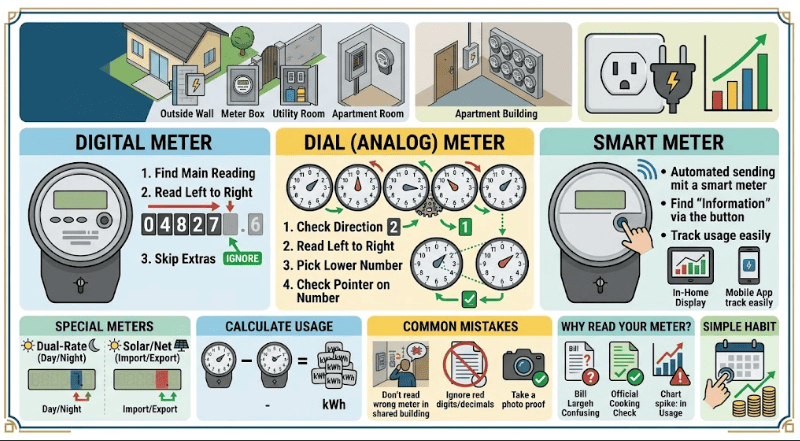
To read an electricity meter, find the main kWh display and write down the numbers from left to right. Ignore any digits shown in red or after a decimal point. On a dial meter, read each dial from left to right and record the lower number when a pointer sits between two numbers. To find how much electricity you used, subtract your last reading from the new one. The result is your usage in kilowatt-hours (kWh), also called units.
Key Points at a Glance
- All home electricity meters count energy in kilowatt-hours (kWh), often called “units” on bills.
- Digital meters: read the main number left to right and skip red digits or decimals.
- Dial (analog) meters: next-door dials turn in opposite directions, so check each dial’s direction.
- Dual-rate meters show two readings (day and night). You need both.
- Solar or net meters show an import reading and an export reading.
- Usage = new reading − old reading. Multiply by your price per unit to estimate the bill.
Why You Should Read Your Own Electricity Meter
Your electricity company bills you based on meter readings. When nobody reads the meter, many suppliers send an estimated bill based on your past usage. Estimates can be too high, which means you pay more than you should, or too low, which leads to a big catch-up bill later.
Reading the meter yourself takes less than two minutes. It helps you check that your bill is correct, spot sudden jumps in usage, and understand which months cost you the most. If your bills keep rising, our guide on how to reduce your electricity bill at home shows practical ways to cut usage once you know your numbers.
Where Is My Electricity Meter?
Before you can read it, you need to find it. Common places include:
- On an outside wall of the house, often near the side or back
- In a meter box at the front gate or boundary wall
- Under the stairs, in a hallway cupboard or a utility room
- In a shared meter room in apartment buildings
- Next to the main electrical panel or fuse board
In apartment buildings, several meters may sit side by side. Match the meter serial number printed on the meter with the number on your electricity bill so you read the correct one.
Understanding kWh: What Your Meter Is Counting
Every electricity meter measures the same thing: energy used over time, shown in kilowatt-hours (kWh). One kWh equals running a 1,000-watt appliance for one hour. For example, a 100-watt fan running for 10 hours uses 1 kWh.
In many countries, bills call these kWh “units.” So when someone says they used 300 units this month, they mean 300 kWh. The number on your meter keeps growing from the day it was installed, which is why a single reading alone does not tell you much. You need two readings to see your actual usage.
How to Read a Digital Electricity Meter
Digital meters are the most common type in homes today. They have an electronic screen (LCD) that shows numbers.
- Find the main reading. Look for “kWh,” “Total,” “Import” or a screen with no label at all. Some meters show the reading all the time; others need you to press a button.
- Read left to right. Write down the main digits in order, including any zeros at the start.
- Skip the extras. Ignore digits after a decimal point and any digits shown in red or inside a separate box. These are fractions of a unit.
- Note the date. Write the date next to the reading, or take a clear photo on your phone.
Example: If the screen shows 04827.6 kWh, your reading is 04827.
Tip for scrolling screens: Many digital meters cycle through several screens, such as time, date, voltage and test patterns like “888888.” Watch the display for one full cycle and only write down the screen labelled kWh or total energy.
How to Read a Dial (Analog) Electricity Meter
Older homes may still have a mechanical meter with four to six small clock-like dials. Each dial points to a number from 0 to 9. These meters are easy to misread, so go slowly.
- Check the direction of each dial. Neighbouring dials turn in opposite directions. One moves clockwise, the next moves anticlockwise. Small arrows or the order of the numbers show which way each one turns.
- Read from left to right. Ignore any red dial or any dial marked “1/10.”
- Pick the lower number. When a pointer sits between two numbers, write down the smaller one. If it sits between 9 and 0, write 9.
- Check pointers that sit exactly on a number. Look at the dial to its right. If that dial has not yet passed 0 (it shows 9, 8 or similar), reduce your number by one. If it has passed 0, keep your number.
Example: Five dials point to 3, between 6 and 7, exactly on 2, 9 and 4. The second dial gives 6. The third dial looks like 2, but the dial on its right shows 9, which means it has not passed 0 yet, so the third digit becomes 1. Your reading is 36194.
How to Read a Smart Meter
A smart meter sends readings to your supplier automatically, so in most cases you do not need to submit anything. Still, it is worth checking now and then, because smart meters can lose signal and fall back to estimated bills.
- Press the display button (often labelled “A,” “Display” or a small arrow) until you see the kWh total, sometimes shown as “IMP kWh” or “Total Import.”
- Write down the digits before the decimal point.
- Many smart meters come with an in-home display or a mobile app that shows daily, weekly and monthly usage and cost. This is the easiest way to track your consumption.
How to Read a Dual-Rate (Day/Night) Meter
If you pay a cheaper price at night or during off-peak hours, you likely have a dual-rate or time-of-use (TOU) meter. It records two separate readings.
- Two rows of numbers: the top row is usually “Low” or “Night” (off-peak), and the bottom row is “Normal” or “Day” (peak).
- One screen that switches: some meters show “Rate 1” and “Rate 2” one after the other, or need a button press to switch.
- Write down both readings and label them. Your supplier needs both to bill you correctly.
Not sure which rate is which? Write down both numbers in the morning and check again in the afternoon. The number that has gone up during the day is your day (peak) rate.
How to Read a Solar or Net Meter (Import and Export)
Homes with solar panels usually have a bi-directional or net meter. It counts electricity you take from the grid and electricity your panels send back. Most of these meters show short codes next to each reading:
| Code on display | What it means |
|---|---|
| 1.8.0 | Total import: electricity you used from the grid |
| 2.8.0 | Total export: electricity your solar sent to the grid |
| 1.8.1 / 1.8.2 | Import split by rate (peak and off-peak) |
| 2.8.1 / 2.8.2 | Export split by rate |
Codes can differ between meter brands, so check the label or your supplier’s guide. Your net usage for a month is roughly import used minus export sent, depending on how your supplier credits exported units.
How to Read a Prepaid Electricity Meter
Prepaid (pay-as-you-go) meters work differently. Their main screen usually shows your remaining credit in units or money, not your total usage. To read one:
- Check the default screen for remaining balance or units left.
- Use the keypad or a display button to see total kWh used, which is often shown with a code or short label in the manual.
- Keep an eye on the low-credit warning light so your power does not cut off unexpectedly.
How to Calculate Your Electricity Usage from Meter Readings
This is where reading your meter really pays off. Use this simple formula:
Units used = Current reading − Previous reading
Worked example:
- Reading on 1 October: 04827
- Reading on 1 November: 05139
- Units used: 05139 − 04827 = 312 kWh
To estimate the energy part of your bill, multiply units used by your price per unit. If your rate is 0.20 per kWh in your local currency, 312 × 0.20 = 62.40. Your real bill may also include fixed charges, taxes and tiered (slab) pricing, so this number is a close estimate, not the final total. For a full breakdown of every charge, see our guide on how to read your electricity bill.
Common Meter Reading Mistakes to Avoid
- Including red digits or decimals. This makes your reading ten times too high.
- Reading the wrong meter in a shared building. Always check the serial number.
- Copying a non-energy screen such as time, voltage or a meter ID number.
- Forgetting the second rate on a day/night meter.
- Misreading dial directions on an analog meter.
- Not keeping proof. A dated photo settles most billing disputes quickly.
When Your Meter Reading Looks Wrong
If your usage suddenly jumps by a large amount without any change in your habits, do a quick test. Switch off every appliance and the main breakers you can safely turn off, then watch the meter. If the reading keeps climbing or a usage light keeps flashing, there may be a wiring fault, a hidden load, or a meter problem. Learn the warning signs in our guide to signs of a faulty electric meter, and contact your supplier for an official meter test. Never open the meter case yourself; it is sealed and belongs to the utility company.
Simple Habit: Keep a Monthly Meter Log
Read your meter on the same date each month and note the reading in a notebook or phone spreadsheet. After a few months, you will see clear patterns, such as higher summer use from air conditioning or winter use from heaters. This log also helps you check every bill in seconds.
Your log is also the easiest way to test a money-saving change. Try lowering your heating by 1°C for a week, then compare readings. Our guide to the best thermostat temperature to save electricity shows the exact settings to start with.
Frequently Asked Questions
Which numbers do I read on an electricity meter?
Read the main kWh digits from left to right. Ignore digits after the decimal point and any digits in red or in a separate box.
Do I read an electric meter from left to right or right to left?
Write the reading down from left to right. On dial meters, some people check dials from right to left to handle pointers sitting exactly on a number, but the final number is always written left to right.
What does kWh mean on my meter?
kWh stands for kilowatt-hour, the unit used to measure electricity. One kWh is the same as one “unit” on most electricity bills.
How do I know if my meter reading is estimated?
Your bill usually marks the reading with an “E,” “Est” or the word “estimated.” An “A” or “actual” means a real reading was taken.
Why does my meter show 888888?
That is a display test. The screen lights up every segment to show it works. Wait for the cycle to continue to the kWh reading.
How often should I read my electricity meter?
Once a month is enough for most homes. Reading it on the same date each month makes it easy to compare usage and check your bills.
Final Thoughts
Learning how to read an electricity meter is a small skill that saves real money. Whether you have a digital, dial, smart, dual-rate, solar or prepaid meter, the steps are simple: find the kWh reading, skip the extra digits, and compare it with your last reading. Do it once a month, keep a photo record, and you will always know exactly what you are paying for.

Muhammad Amjad Butt
Founder of HomeKiTips
Muhammad Amjad Butt is the founder of HomeKiTips. He writes practical guides on home repair, maintenance, cleaning and decor. Each guide is built from manufacturer instructions, building standards and current cost data, then turned into clear steps that anyone can follow. For structural work, he always recommends a qualified tradesperson.
You may also like
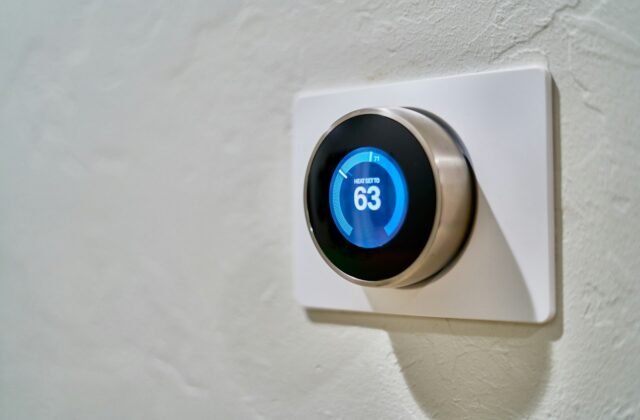
Best Thermostat Temperature to Save Electricity in Winter & Summer (Plus 7 Hacks)
Set 19–20°C (66–68°F) in winter and 24–26°C (75–78°F) in summer. Learn the best thermostat temperature to save electricity, plus 7…
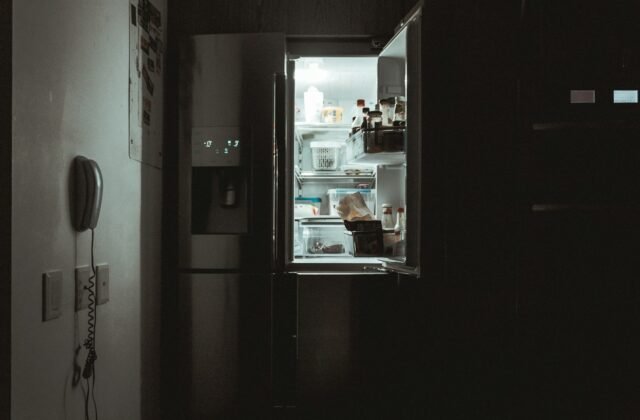
Best Fridge Temperature to Save Electricity (Plus 7 Easy Hacks)
Find the best fridge temperature to save electricity: 4°C fridge, -18°C freezer. See what dial 1–7 means and try 7…

How to Reduce Moisture in Your Home
Learn how to reduce moisture in your home to stop hidden leaks, cockroaches and dust mites, with safe humidity levels…
Questions and tips from readers (2)