Kitchen Deep Cleaning Checklist: Fridge to Sink (Step by Step)
A kitchen deep clean means cleaning every surface from the ceiling down to the floor, not just the counters and dishes. Work in this order: declutter, high surfaces, fridge, oven and stove, counters, sink, then the floor last. For an average kitchen this takes 3–4 hours, and you should do it about every 3 months.
Here is something that surprises most people: the dirtiest thing in your house is not the toilet. It is the sponge you use to wash your dishes. In a well-known NSF International study, more than 75% of dish sponges and rags tested positive for coliform bacteria, the same bacteria family that includes E. coli and Salmonella. So if your kitchen looks clean, it might not be clean.
In this article
- Why Your Kitchen Needs a Deep Clean
- What Is the Difference Between Deep Cleaning and Regular Cleaning?
- What Supplies Do You Need?
- What Order Should You Clean a Kitchen In?
- How to Deep Clean the Fridge
- How to Clean the Oven, Stove and Microwave
- How to Clean Counters, Cabinets and Backsplash
- How to Clean and Sanitize the Kitchen Sink
- How to Finish with the Floor
- How Often Should You Deep Clean Your Kitchen?
- Kitchen Cleaning Mistakes to Avoid
- FAQ
- Start Your Kitchen Deep Clean This Weekend
This kitchen deep cleaning checklist takes you through each zone step by step. You get exact times, simple supplies and a schedule you can actually stick to. It works whether you have a small apartment kitchen or a big family one.
Why Your Kitchen Needs a Deep Clean
Your kitchen sees raw meat, wet hands, food crumbs and steam every single day. Germs love that mix of warmth, moisture and food. Daily wiping handles the mess you can see, but grease, bacteria and old food build up in places you rarely touch.
The NSF International “Germiest Places in the Home” study swabbed 30 everyday items in 22 family homes. Most people expected the bathroom to be the dirtiest room. In fact, the kitchen came out on top. NSF says food prep areas had far more bacteria and fecal contamination than many other spots in the house.
- Dish sponges and rags: 77% carried coliform bacteria
- Kitchen sinks: 45% carried coliform bacteria
- Countertops: about 32% carried coliform bacteria
- Stove knobs: about 14% carried coliform bacteria
A kitchen can look spotless and still be the germiest room in your home.
Real example: Sara, a mother of two, wiped her counters every night but kept getting a sour smell near the sink. On a deep clean she found a layer of grease and old food under the dish rack and a sponge that had not been replaced in six weeks. Once she cleaned that area and started swapping sponges weekly, the smell was gone within two days.
What Is the Difference Between Deep Cleaning and Regular Cleaning?
Regular cleaning is the quick, daily work: wiping counters, washing dishes, sweeping crumbs. It takes 10–15 minutes.
Deep cleaning reaches the places you skip every day: inside the fridge, behind the stove, the range hood filter, the tops of cabinets and the drain. It takes 3–4 hours and is done every 3–6 months.
Two more terms are worth knowing:
- Cleaning removes dirt, grease and food with soap and water.
- Sanitizing or disinfecting kills germs left on the surface. You must clean first, because disinfectant does not work well through grease and crumbs.
Key insight: Always clean first, then sanitize. Spraying disinfectant on a greasy counter is like washing your hands with gloves on.
What Supplies Do You Need?
You do not need expensive products. Most of a kitchen deep clean can be done with things you already have.
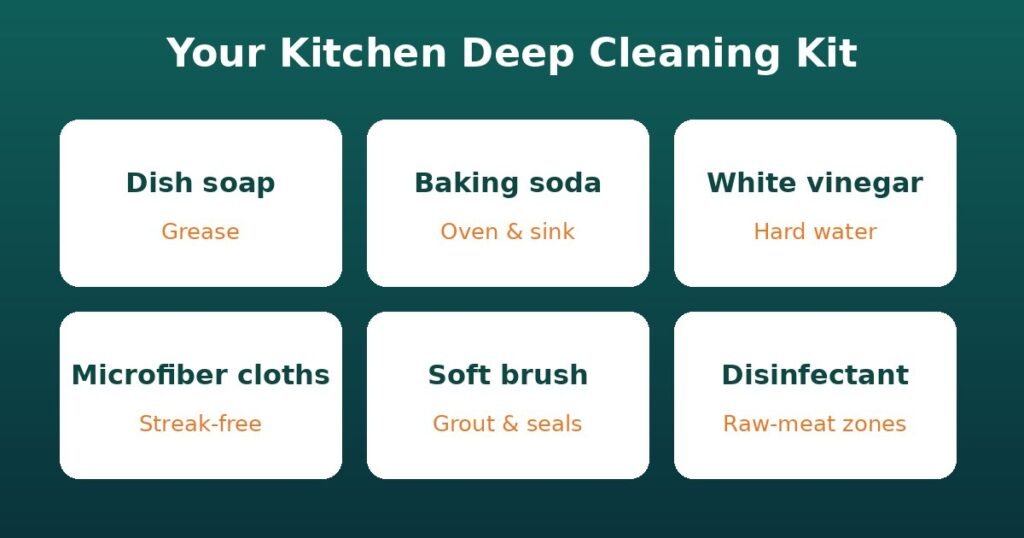
- Dish soap: cuts grease on cabinets, hoods and stove tops
- Baking soda: a gentle scrub for ovens, sinks and stains
- White vinegar: removes hard water spots and soap film
- Microfiber cloths (4–6): pick up dust and dry without streaks
- Soft brush or old toothbrush: for grout, seals and corners
- A disinfectant or diluted bleach: for raw-meat zones, sinks and cutting boards
- Rubber gloves and a bucket
If you have a tile backsplash with white crusty marks, the vinegar method in our guide on removing hard water stains from tiles and glass works on kitchen tiles too.
What Order Should You Clean a Kitchen In?
The golden rule is top to bottom, dry to wet. Dust and crumbs fall down as you clean, so the floor always goes last. Follow this order:
- Declutter and soak (15 min): Clear the counters, empty the dish rack and soak the stove grates and hood filter in hot, soapy water.
- Ceiling, fan and light (10 min): Dust cobwebs and wipe the light cover.
- Cabinet tops and range hood (20 min): These collect a sticky layer of grease and dust.
- Fridge inside and out (40 min)
- Oven, stove and microwave (45 min)
- Counters, cabinet fronts and backsplash (30 min)
- Sink and drain (15 min)
- Floor last (20 min)
This adds up to about 3 hours 15 minutes. The soaking in step 1 does half the scrubbing work for you while you clean the rest.
How to Deep Clean the Fridge
Oregon State University Extension says there is no fixed rule, but a full fridge clean every couple of months helps prevent food spoilage and the spread of Listeria.
- Take everything out. Put perishables in a cooler bag, and keep them out for under 2 hours.
- Throw away expired food, old leftovers and anything with mould.
- Remove the shelves and drawers. Wash them in warm, soapy water. Let glass shelves reach room temperature first so they don’t crack.
- Wipe the walls, ceiling and door seals. Use a toothbrush on the rubber gasket where crumbs and mould hide.
- Dry everything, put it back and place an open box of baking soda inside to absorb odours.
Real example: A family of five who shop on Saturdays started doing a 10-minute “fridge check” every Friday night. Their full fridge clean went from a 90-minute job to just 30 minutes, because spills never got the chance to dry and stick.
How to Clean the Oven, Stove and Microwave
Oven
Mix half a cup of baking soda with 3–4 tablespoons of water to make a paste. Spread it inside the cold oven, avoiding the heating elements. Leave it for at least 8 hours or overnight. Then wipe it off with a damp cloth and spray a little vinegar on any white residue left behind.
Stove top and knobs
Wipe the soaked grates clean and rinse. Pull off the knobs if they come off, and wash them in soapy water. Remember, NSF found germs and mould on stove knobs, because we touch them with raw-food hands.
Microwave
Put a bowl with 1 cup of water and 2 tablespoons of vinegar inside. Heat it for 3–5 minutes and leave the door shut for another 2 minutes. The steam softens dried food, so everything wipes off in one pass.
Range hood filter
After a 15–20 minute soak in very hot water with dish soap and a spoon of baking soda, scrub the filter with a soft brush, rinse and let it dry fully.
Let soaking and steam do the hard work. Scrubbing is the last step, not the first.
How to Clean Counters, Cabinets and Backsplash
Cabinet fronts near the stove get a thin, sticky film of cooking grease. Wipe them with warm water and a few drops of dish soap, then dry them with a microfiber cloth. Pay extra attention to handles, because everyone touches them.
For counters, clean them with soapy water first, then sanitize any area that touched raw meat, chicken or eggs. Be careful with natural stone. Vinegar and lemon can dull marble and granite, so use a pH-neutral cleaner on those. Our guide on natural ways to make marble and tile shine explains what is safe for stone.
Finally, scrub the backsplash grout lines with a toothbrush and a baking soda paste, then wipe them clean.
How to Clean and Sanitize the Kitchen Sink
The sink is the second germiest spot in the kitchen. Food scraps, raw meat juice and dirty dishes all pass through it.
- Sprinkle baking soda over the sink and scrub with a damp sponge or brush.
- Rinse, then disinfect the sides and bottom. NSF suggests doing this once or twice a week with a disinfectant or a mix of about 1 tablespoon of bleach in 1 gallon (around 4 litres) of water.
- Clean the tap and handles, which are one of the most touched spots in the kitchen.
- For the drain, pour half a cup of baking soda followed by 1 cup of vinegar. Wait 10 minutes, then flush with hot water.
What about the sponge?
A USDA Agricultural Research Service study found that microwaving a wet sponge for 1 minute killed 99.9999% of bacteria, and a dishwasher cycle with heated drying was almost as effective. Make sure the sponge is fully wet and has no metal parts before you microwave it. Even with this, replace your sponge every 1–2 weeks.
Quick win this week: Tonight, soak your sponge, microwave it for 60 seconds and wash your kitchen towels on a hot cycle. It takes 5 minutes and removes the two biggest germ sources in your kitchen.
How to Finish with the Floor
Now that all the crumbs and drips have fallen, the floor is the final step.
- Pull out light appliances like a bin or a trolley and sweep behind them.
- Vacuum or sweep corners and under the cabinet kick plates.
- Mop with warm water and a small amount of floor cleaner suited to your floor type.
- Scrub sticky spots near the stove and in front of the sink by hand.
The same top-to-bottom method is what we use in our living room cleaning checklist, so once you learn it, every room gets faster.
How Often Should You Deep Clean Your Kitchen?
A full deep clean every 3 months works for most homes. If you cook every day, have a big family or have pets, aim for every 6–8 weeks. Between deep cleans, this simple schedule keeps the work small:
- Daily (10–15 min): wipe counters, wash dishes, rinse the sink, sweep crumbs
- Weekly (30 min): microwave, stove top, mop the floor, throw out old food, swap the sponge
- Monthly (1 hour): oven, range hood filter, dishwasher filter, cabinet fronts
- Every 3–6 months (3–4 hours): full fridge clean, pantry shelves, fridge coils, behind the stove and fridge
Real example: A working couple split the weekly tasks: one person does the microwave and stove on Wednesday, the other mops on Sunday. Their quarterly deep clean now takes under 3 hours, compared with a full Saturday before.
Want the same plan for the rest of the house? See our guide on how to deep clean your bedroom in under an hour and the kids’ room cleaning guide.
Kitchen Cleaning Mistakes to Avoid
- Mixing cleaners. The Washington State Department of Health warns that mixing bleach with ammonia creates toxic chloramine gases. Bleach mixed with acids such as vinegar can release chlorine gas. Use one product, rinse, then use the next.
- Cleaning the floor first. You will have to do it again.
- Using one cloth for everything. Keep a separate cloth for raw-meat areas so you don’t spread germs.
- Using vinegar on stone. It can etch marble and granite.
- Keeping a sponge too long. If it smells, it’s already full of bacteria.
- Forgetting the hidden spots: fridge seals, stove knobs, cabinet handles and the top of the fridge.
FAQ
How long does it take to deep clean a kitchen?
Most kitchens take 3–4 hours. A small apartment kitchen can be done in about 2 hours, and a large family kitchen with a very dirty oven may need 5 hours.
What should a kitchen deep cleaning checklist include?
It should include the ceiling and light, cabinet tops, range hood and filter, fridge inside and out, oven, stove, microwave, counters, backsplash, cabinet fronts, sink, drain and floor.
Can I deep clean my kitchen with only natural products?
Yes, for most of it. Dish soap, baking soda and vinegar handle grease, stains and hard water. For areas that touched raw meat, a proper disinfectant gives better germ control.
How often should I replace my kitchen sponge?
Every 1–2 weeks. Microwave it wet for 1 minute every few days in between to cut down bacteria.
What is the dirtiest place in a kitchen?
The dish sponge or rag, followed by the sink, according to the NSF International germ study.
Start Your Kitchen Deep Clean This Weekend
A clean kitchen is not about spending a whole day scrubbing. It’s about the right order and small habits that stop dirt from building up. Use this kitchen deep cleaning checklist once, and every clean after that will be faster.
Your action plan:
- Block out 3–4 hours this weekend and gather your supplies.
- Soak the stove grates and hood filter first.
- Clean top to bottom: high surfaces, fridge, oven, counters, sink, then the floor.
- Sanitize the sink, raw-meat areas and handles after cleaning.
- Replace or microwave your sponge and wash kitchen towels on hot.
- Stick the daily, weekly and monthly schedule on your fridge.
- Book your next deep clean for 3 months from today.
Your kitchen feeds your family every day. Give it 3 hours, and it will feel like a new room. Start this weekend.

Muhammad Amjad Butt
Founder of HomeKiTips
Muhammad Amjad Butt is the founder of HomeKiTips. He writes practical guides on home repair, maintenance, cleaning and decor. Each guide is built from manufacturer instructions, building standards and current cost data, then turned into clear steps that anyone can follow. For structural work, he always recommends a qualified tradesperson.
You may also like
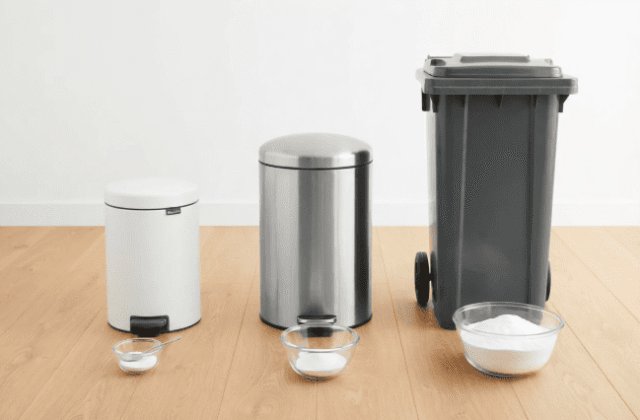
How Much Baking Soda for Trash Can Odor Should You Use?
Use 2 tbsp for small bins, ½ cup for kitchen bins, and 1–1½ cups for outdoor bins. Get exact baking…
How to Clean a Washing Machine
Learn how to clean a washing machine step by step: door seal, detergent drawer, tub clean cycle and drain filter,…
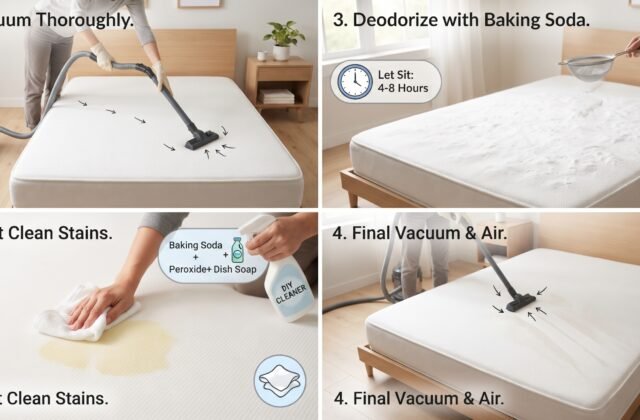
How to Clean a Mattress at Home
Learn how to clean a mattress at home in 6 steps: vacuum, treat stains, deodorise with baking soda and keep…
Questions and tips from readers (1)